
The world of gaming has changed dramatically over the past decade. Video games are no longer simply a form of entertainment played at home. Today, competitive gaming has developed into a global industry involving professional players, esports organisations, tournament platforms, streaming communities, gaming technologies, and millions of fans. Within this rapidly developing environment, the phrase game etruesports can be used to describe the growing connection between modern games and the competitive esports ecosystem.
Game EtrueSports represents an interest in competitive gaming, esports experiences, gaming updates, technology, tournaments, player performance, and the communities that make digital competition exciting. Whether someone is a casual gamer, an aspiring esports player, a content creator, or simply a fan who enjoys watching competitive matches, understanding the modern gaming ecosystem can make the experience more rewarding.
This article explores game esports from different perspectives, including competitive games, esports tournaments, gaming technology, player skills, streaming, community development, and future trends.
Also Read: Gaming Updates from EtrueSports EtrueGames
What Is Game EtrueSports?
Game EtrueSports can be understood as a gaming-focused concept centred on esports and competitive digital entertainment. ‘Esports’ refers to organised competitive video gaming where individuals or teams compete according to specific rules, often in tournaments or professional leagues.
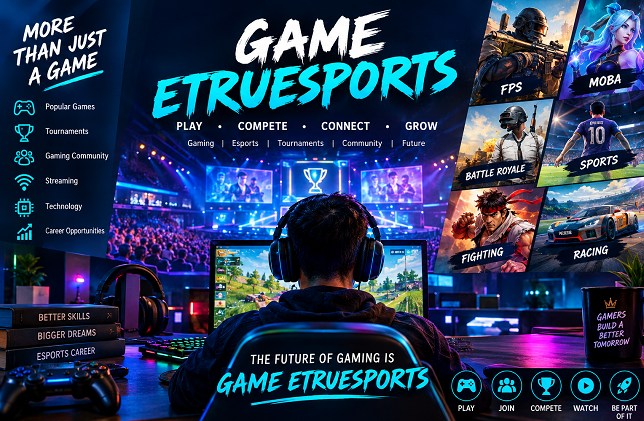
Modern esports can include many different genres. Multiplayer online battle arena games, first-person shooters, battle royale titles, sports games, fighting games, racing games, and strategy games can all support competitive communities.
The important part is not simply playing a video game. Competitive gaming adds structured competition, measurable performance, teamwork, strategy, rankings, tournaments, and spectatorship.
For gamers interested in game etruesports, this means there are many ways to participate. A person can play competitively, watch tournaments, follow professional players, create gaming content, analyse matches, or participate in an online community.
Why Game EtrueSports Is Becoming Popular
One major reason competitive gaming continues to attract attention is accessibility. A traditional sport may require a specific physical location or equipment, while many video games can be played online with relatively accessible hardware.
Internet connectivity has also transformed gaming. Players from different cities and countries can compete against one another without being physically present in the same location.
Streaming platforms have further expanded the esports audience. Fans can watch live matches, follow professional players, learn strategies, and interact with other viewers. This has helped turn esports from a niche hobby into a major entertainment category.
Another important factor is the development of gaming hardware. Faster processors, better graphics cards, high-refresh-rate displays, responsive controllers, gaming mice, keyboards, and improved networking equipment can all contribute to a more competitive experience.
Popular Types of Competitive Games
Game etruesports covers a broad range of gaming genres. Each category requires different skills and strategies.
| Game Genre | Important Skills | Competitive Features |
|---|---|---|
| First-Person Shooter | Aim, reflexes, teamwork | Ranked matches and tournaments |
| MOBA | Strategy, teamwork, decision-making | Professional leagues |
| Battle Royale | Survival, positioning, aim | Large-player competitions |
| Fighting Games | Timing, reactions, combos | One-on-one tournaments |
| Racing Games | Control, precision, consistency | Time trials and races |
| Sports Games | Tactical thinking, reactions | Competitive leagues |
| Strategy Games | Planning, resource management | Long-form competitive matches |
First-person shooters often emphasise accuracy, communication, map knowledge, and fast reactions. MOBA games generally require teamwork, strategic planning, character knowledge, and strong decision-making.
Battle royale competitions add another layer because players must balance combat with survival and positioning. Racing and sports games, meanwhile, can demand precision, timing, and extensive knowledge of game mechanics.
The Importance of Esports Skills
Being successful in competitive gaming requires more than simply playing for many hours. Effective practice is usually structured and purposeful.
One of the most important skills is game knowledge. Players need to understand maps, characters, weapons, abilities, objectives, strategies, and game mechanics.
Communication is particularly important for team-based games. A team may contain several highly skilled individuals, but poor communication can prevent them from performing effectively.
Decision-making is another essential skill. Competitive players often have only seconds to decide whether they should attack, defend, retreat, rotate, or support a teammate.
Mechanical skills also matter. These can include aiming, movement, timing, accuracy, reaction speed, and precise control.
Finally, competitive players need mental discipline. Losing a match can create frustration, but professional improvement requires the ability to identify mistakes and continue practising.
Game EtrueSports and Gaming Technology
Technology plays a central role in modern competitive gaming.
High-refresh-rate monitors can make fast-moving gameplay appear smoother. Gaming mice and keyboards can provide precise input. Powerful computers can maintain stable frame rates in demanding games.
Network quality is equally important. Competitive players depend on stable connections because high latency can affect responsiveness. A player with excellent skills can still struggle if their connection frequently experiences interruptions or excessive delay.
Game developers also continue to improve online infrastructure, matchmaking systems, anti-cheat technologies, graphics engines, and competitive features.
Artificial intelligence may become increasingly important as well. AI-powered systems can potentially assist with player analytics, training tools, matchmaking, moderation, and personalised recommendations.
The Role of Esports Tournaments
Tournaments are one of the most visible parts of the esports ecosystem. They provide competitive players with opportunities to test their skills against strong opponents.
A tournament can range from a small community competition to a major international event. Competitions may use knockout brackets, group stages, leagues, or other formats.
Successful tournaments usually provide more than gameplay. They can include live commentary, statistics, interviews, highlights, analysis, entertainment, and audience interaction.
For fans interested in game etruesports, following tournaments can be an excellent way to learn advanced strategies. Watching high-level players can reveal positioning techniques, communication patterns, resource management, and decision-making that casual players may not notice.
Streaming and Game EtrueSports
Streaming has become closely connected with competitive gaming. Professional players, creators, coaches, and gaming personalities can broadcast their gameplay to audiences around the world.
A gaming stream can serve several purposes. Viewers may watch for entertainment, learn strategies, discover new games, or interact with a creator.
For aspiring esports players, streaming can also help build a personal brand. Consistent content, useful commentary, engaging communication, and a positive community can help creators develop an audience.
However, streaming success requires more than playing well. Content quality, consistency, personality, communication, and audience understanding are also important.
How Beginners Can Enter Competitive Gaming
Someone who is new to game etruesports does not need to become a professional immediately. The best approach is to build skills gradually.
First, choose one game and learn its fundamentals. Constantly switching between many competitive titles can make improvement slower.
Next, understand the basic mechanics. Learn the maps, characters, weapons, objectives, controls, and common strategies.
After that, begin playing ranked or competitive matches. Treat each match as an opportunity to learn rather than focusing only on winning.
Recording gameplay can also help. Reviewing mistakes after a match allows players to identify poor positioning, unnecessary fights, weak communication, or inefficient decision-making.
It is also useful to watch experienced players. Instead of watching only for entertainment, beginners can pay attention to why a player makes a particular decision.
Building a Competitive Gaming Routine
A balanced practice routine can improve performance without requiring endless gaming sessions.
| Practice Area | Suggested Focus |
|---|---|
| Warm-up | Aim, movement, mechanics |
| Ranked Matches | Decision-making and competition |
| Replay Review | Identifying mistakes |
| Strategy Study | Maps and game mechanics |
| Team Practice | Communication and coordination |
| Rest | Recovery and concentration |
Quality is generally more valuable than simply increasing playtime. Long sessions without concentration can lead to fatigue and repeated mistakes.
Taking regular breaks is also important. Competitive gaming requires concentration, and tired players may experience slower reactions and weaker decision-making.
Game EtrueSports Communities
Community is one of the most important parts of gaming culture. Online communities allow players to discuss strategies, share clips, organise competitions, and find teammates.
A healthy gaming community should encourage respectful competition. Toxic behaviour can damage the experience for both new and experienced players.
Players can contribute to positive communities by communicating respectfully, accepting constructive criticism, helping beginners, and avoiding harassment.
Community tournaments can also provide valuable experience. They allow new players to experience organised competition without immediately entering high-level professional environments.
Opportunities Beyond Professional Playing
Not everyone interested in esports needs to become a professional player. The esports industry includes many different roles.
Potential areas include:
- Esports coaching
- Tournament administration
- Game journalism
- Content creation
- Streaming
- Video editing
- Graphic design
- Social media management
- Shoutcasting and commentary
- Event production
- Community management
- Game analysis
This broader ecosystem makes competitive gaming more than a player-versus-player activity. It has become a digital entertainment industry with opportunities across technology, media, marketing, and production.
Challenges in Competitive Gaming
Competitive gaming also has challenges. One of the biggest is maintaining a healthy balance between gaming and everyday responsibilities.
Players may become frustrated after repeated losses. Some may practise excessively without adequate rest. Others may experience pressure when competing in tournaments.
Another concern is online toxicity. Competitive environments can sometimes encourage negative communication.
Cheating is another serious issue. Competitive games depend on fair play, so developers and tournament organisers need effective anti-cheat systems and enforcement policies.
For players, maintaining discipline and a healthy routine is essential. Competitive gaming should be approached as a skill-based activity rather than an excuse to ignore education, work, relationships, sleep, or physical activity.
The Future of Game EtrueSports
The future of game etruesports is likely to be shaped by several technologies and trends.
Cloud gaming could make high-quality games accessible across more devices. Faster internet infrastructure can improve online competition. Artificial intelligence may provide better training and analytical tools.
Virtual reality and augmented reality may also introduce new competitive experiences. While traditional screen-based gaming remains dominant, immersive technologies could create entirely new esports formats.
Mobile esports is another important area. Smartphones have become powerful enough to support competitive multiplayer experiences, making esports accessible to a much wider audience.
The continued growth of gaming communities, streaming, tournaments, and digital entertainment suggests that competitive gaming will remain an important part of modern gaming culture.
Tips for Improving at Game EtrueSports
Players looking to improve should focus on consistency rather than quick results.
1. Choose one main game: Concentrate on learning one title deeply.
2. Learn from mistakes: Losing is useful when you understand why you lost.
3. Practice specific skills: Work on aim, movement, strategy, or communication instead of playing aimlessly.
4. Watch skilled players: Study their decisions rather than copying their actions without understanding them.
5. Communicate clearly: In team games, useful information is often more valuable than constant talking.
6. Protect your focus: Reduce distractions while practising.
7. Take breaks: Rest can help maintain concentration.
8. Track progress: Keep an eye on performance statistics and recurring mistakes.
(FAQs)
What is game etruesports?
Game etruesports refers to the broader concept of competitive gaming and esports, including competitive video games, tournaments, players, technology, streaming, strategies, and gaming communities.
Is game etruesports only for professional players?
No. Competitive gaming is accessible to casual players, beginners, aspiring competitors, content creators, spectators, and professional esports athletes.
Which skills are important for esports?
Important skills include game knowledge, reaction time, mechanical ability, strategic thinking, communication, teamwork, decision-making, and mental discipline.
How can beginners start competitive gaming?
Beginners should select one game, learn its basic mechanics, practise regularly, play ranked matches, review mistakes, and study experienced players.
Is gaming technology important in esports?
Yes. Hardware performance, monitor refresh rates, input devices, networking, game servers, and anti-cheat technology can all influence competitive gaming.
Can gaming become a career?
Yes. Career opportunities can include professional playing, coaching, streaming, content creation, commentary, tournament management, video production, journalism, and esports marketing.
Why are esports tournaments important?
Tournaments create structured competition and give players opportunities to test their skills. They also provide entertainment for fans and help grow gaming communities.
What is the future of game etruesports?
The future may include continued growth in mobile esports, streaming, AI-assisted training, cloud gaming, immersive technologies, improved competitive infrastructure, and international gaming communities.
Conclusion
Game etruesports represents the exciting intersection of video games, competitive gaming, technology, tournaments, streaming, and online communities. As gaming continues to evolve, esports is becoming increasingly accessible to players and audiences worldwide.
Whether someone wants to compete professionally, improve their skills, watch tournaments, create gaming content, or simply understand the esports world, there are many ways to participate.
The most important principles remain simple: practise intelligently, learn from mistakes, communicate effectively, respect other players, and maintain a healthy balance. With the continued development of gaming technology and digital communities, the future of competitive gaming promises to be increasingly connected, interactive, and innovative.