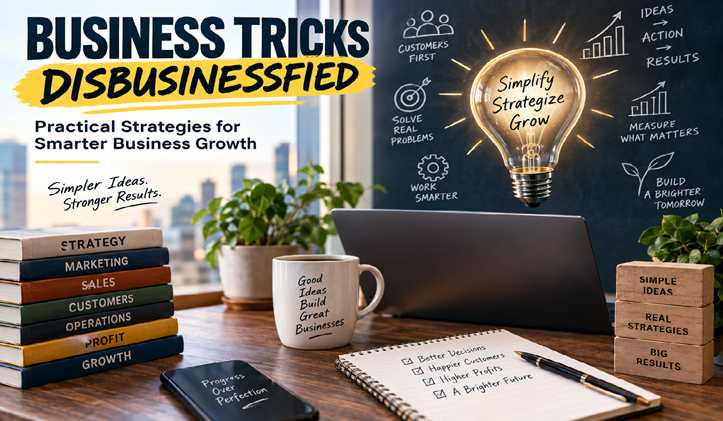

Business growth rarely comes from one brilliant move. More often, it comes from a long series of smart decisions made consistently. That is a useful way to understand business tricks disbusinessfied. The phrase can describe the process of taking complicated business tactics and turning them into practical strategies that are easier to understand and apply.
That distinction matters.
A flashy tactic might generate attention for a few days. A well-designed process can improve a business for years.
The best business strategies also tend to start with a straightforward question: What problem are we actually trying to solve?
From pricing and customer service to marketing and operations, this guide breaks down practical business tricks into actions that business owners can use in the real world.
What Does Business Tricks Disbusinessfied Mean?
Business tricks disbusinessfied is not a standard business term with a universally accepted definition. Rather, it can be viewed as a way of describing simplified business tactics.
The underlying idea is straightforward: take a complicated strategy and reduce it to the decisions and actions that matter most.
Instead of building a plan around dozens of metrics, tools, and processes, start with three questions:
- What problem are we solving?
- What action could improve the situation?
- How will we know whether it worked?
That framework can make business decisions much easier to execute.
Consider a company struggling with customer retention. It could immediately launch a costly loyalty program. But first, it should find out why customers are leaving.
A few customer interviews, support records, and reviews might reveal a recurring onboarding problem.
Fixing that problem could have a bigger impact than another marketing campaign.
That is the practical value of disbusinessfied thinking: simplify the strategy without losing the substance.
Why Simple Business Tricks Often Work Better
Most business owners already have access to plenty of information.
Sales platforms produce reports. Website analytics track visitor behavior. Advertising systems generate performance data. Customer relationship tools record interactions.
The challenge is rarely finding more information.
The challenge is knowing what deserves attention.
Simple strategies can help because they create a clearer connection between an action and its outcome.
For example:
- Improve a product page → measure conversion rate.
- Simplify checkout → measure completed purchases.
- Respond to leads faster → measure qualified appointments.
- Improve customer support → measure retention and satisfaction.
- Eliminate unnecessary expenses → measure operating margin.
The objective isn’t to make business simplistic. It’s to remove complexity that doesn’t improve the decision.
10 Practical Business Tricks Disbusinessfied
1. Solve One Expensive Problem First
Strong businesses usually solve problems that customers genuinely care about.
Look for problems that cost people time, money, effort, or peace of mind.
A minor inconvenience may not create enough motivation to buy. A costly problem usually does.
Imagine a software company selling scheduling tools. Customers may not care about having another calendar feature.
They may care about reducing missed appointments.
That distinction changes the entire sales message.
How to apply this strategy
Talk directly with customers and ask:
- What takes too much time?
- Where are you losing money?
- What causes repeated mistakes?
- Which process frustrates your employees?
- What problem would you gladly pay someone to eliminate?
Look for patterns rather than isolated comments.
Once you identify the problem with the greatest business impact, build your offer around solving it.
2. Make Your Offer Easy to Understand
Confusing offers create friction before a customer even considers buying.
A prospective customer should quickly understand:
- What you sell
- Who it is for
- What problem it solves
- How your solution is different
- What they should do next
Compare these two statements:
“We provide innovative digital transformation solutions for modern organizations.”
Now consider:
“We help small retailers reduce manual inventory work with simple software.”
The second version gives the reader a reason to keep going.
It identifies the customer, the problem, and the solution without forcing the reader to decode corporate language.
Clarity is a competitive advantage.
3. Track Profit, Not Just Revenue
Revenue is an important number, but it does not tell the whole story.
A company generating $500,000 in sales may be financially weaker than a company generating $300,000 with healthier margins, better cash flow, and lower acquisition costs.
Depending on the business model, useful metrics can include:
- Gross profit margin
- Operating margin
- Customer acquisition cost
- Customer lifetime value
- Conversion rate
- Average order value
- Cash flow
- Customer retention
That doesn’t mean you need a dashboard filled with every metric imaginable.
Track the numbers that influence actual decisions.
A practical example
Suppose an advertising campaign generates $10,000 in sales but costs $8,000 to acquire those customers.
The revenue figure sounds encouraging.
The underlying economics are much less attractive.
Looking beyond revenue helps reveal whether growth is actually creating value.
4. Turn Customer Complaints Into Product Ideas
Customer complaints can be frustrating, but they can also provide some of the most useful market research available to a business.
Repeated complaints may reveal:
- A missing feature
- A confusing process
- A pricing issue
- A delivery problem
- A communication gap
- A weakness compared with competitors
That doesn’t mean every complaint should become a product requirement.
Look for repetition.
If customers independently report the same issue again and again, the pattern deserves attention.
Combine that feedback with sales, support, and retention data before making a major change.
Customer feedback becomes much more valuable when it helps explain the numbers.
5. Follow Up More Consistently
Businesses often lose sales because they stop communicating too early.
A prospect may not reject an offer. They may simply get busy, miss an email, or need more information before deciding.
A thoughtful follow-up sequence might include:
- An initial response
- Helpful information
- A reminder
- A relevant case study or example
- A final check-in
The key is to make each interaction useful.
Instead of repeatedly asking, “Are you ready to buy?” share something that helps the prospect make a better decision.
For example, explain how another customer solved a similar problem.
Good follow-up feels helpful.
Poor follow-up feels like pressure.
6. Use Social Proof Carefully
People naturally look for evidence before committing their money.
Useful forms of social proof include:
- Customer reviews
- Testimonials
- Case studies
- Independent ratings
- Before-and-after results
- Client logos
- Industry certifications
Quality matters more than quantity.
Ten detailed testimonials can be more convincing than hundreds of vague comments.
Whenever possible, show the actual outcome.
For example:
“The new process reduced average processing time from three days to one.”
That communicates far more than:
“Great service!”
Businesses should also avoid fabricated reviews and exaggerated claims.
Trust is a business asset. Once damaged, it can be difficult to rebuild.
7. Make Buying Easier
Every unnecessary step in the buying process creates another chance for a customer to leave.
Walk through the customer journey yourself and look for friction.
Check for:
- Long forms
- Confusing pricing
- Unexpected fees
- Slow-loading pages
- Unclear shipping information
- Complicated checkout
- Missing contact details
- Weak product descriptions
You don’t always need a complete website redesign.
Sometimes removing one unnecessary step can make a meaningful difference.
A simple test
Buy your own product or service as if you were a first-time customer.
Don’t rely on employees who already understand the system.
Experience the process without insider knowledge.
You may uncover problems your team no longer notices because they’ve become accustomed to them.
Business Tricks Compared With Traditional Business Advice
| Approach | Traditional Approach | Disbusinessfied Approach |
|---|---|---|
| Goal | Broad growth | Specific business outcome |
| Strategy | Complex plans | Focused actions |
| Data | Track everything | Track useful metrics |
| Customers | Assume preferences | Ask and observe |
| Marketing | Maximize exposure | Improve relevance |
| Competition | Copy competitors | Find customer problems |
| Improvement | Occasional projects | Continuous testing |
| Risk | Make large bets | Test before scaling |
The difference isn’t about choosing simple tools over sophisticated ones.
It’s about making the relationship between a decision and its outcome easier to understand.
How to Apply These Strategies to a Small Business
Small businesses often operate with limited staff, time, and capital.
That makes prioritization especially important.
Trying to fix everything at once usually creates more work without producing better results.
Start with this five-step process
Step 1: Identify the bottleneck
Find the biggest factor holding the business back.
It could be lead generation, conversion, delivery capacity, customer retention, or cash flow.
Step 2: Measure the baseline
Record the current result before making changes.
If a website converts 2% of visitors, that becomes your starting point.
Step 3: Change one variable
Avoid changing several major elements at the same time.
Testing one meaningful change makes the result easier to interpret.
Step 4: Review the evidence
Compare performance before and after the change.
Don’t assume the change caused the improvement without considering other factors.
Step 5: Standardize what works
If the change produces a reliable benefit, turn it into a repeatable process.
That’s how individual improvements become business systems.
Pros and Cons of the Disbusinessfied Approach
Pros
- Makes complicated strategies easier to execute
- Encourages measurable decision-making
- Reduces unnecessary business complexity
- Helps small teams prioritize
- Promotes customer-focused thinking
- Makes experimentation more manageable
- Can reduce wasted spending
Cons
- Simple strategies can overlook complex market conditions
- Short-term measurements can produce misleading conclusions
- Not every business problem has a simple solution
- Excessive simplification can remove important context
- Some industries require sophisticated systems and controls
The objective isn’t simplification for its own sake.
A good strategy should be as simple as possible without removing information that matters.
Expert Tips for Using Business Tricks Disbusinessfied
Focus on bottlenecks
Don’t spend most of your time optimizing something that already performs well.
Find the constraint that limits the rest of the business.
Calculate before spending
Before increasing an advertising budget, understand customer acquisition cost, conversion performance, margins, and customer value.
More spending cannot rescue a fundamentally weak offer.
Talk to customers regularly
Analytics can show what customers do.
Customer conversations can help explain why they do it.
Use both sources.
Test small before scaling
Small experiments limit downside risk.
If an idea produces promising results, increase the investment gradually.
Document successful processes
When a process works, document it.
Written procedures make training easier, improve consistency, and reduce dependence on one employee.
Protect customer trust
Don’t trade transparency for a quick sale.
Clear pricing, honest claims, reliable service, and responsive support create stronger long-term relationships.
(FAQs) About Business Tricks Disbusinessfied
What are business tricks disbusinessfied?
Business tricks disbusinessfied can be understood as simplified explanations of practical business tactics. The concept focuses on turning complicated strategies into clear, actionable steps.
Is business tricks disbusinessfied an official business term?
No. The phrase does not have a universally recognized definition in mainstream business terminology. It’s better treated as a descriptive concept for simplifying business strategies.
What is the most useful business trick for small companies?
Start by identifying the biggest bottleneck. Improving the factor that currently limits growth can produce better results than making dozens of unrelated changes.
How can I improve my business without spending more money?
Start by improving existing processes. Better follow-up, clearer offers, customer feedback, faster service, and a simpler buying experience can often improve performance without major new spending.
Why should businesses track profit instead of revenue?
Revenue shows how much a company generates through sales. Profit shows what remains after relevant costs. A business can increase revenue while becoming less profitable.
How does customer feedback help a business?
Customer feedback can reveal product weaknesses, service problems, pricing concerns, and unmet needs. Repeated feedback can highlight opportunities for meaningful improvements.
Should every business use social proof?
Most businesses can benefit from credible social proof. Reviews, testimonials, and case studies can reduce customer uncertainty. Businesses should never fabricate or manipulate reviews.
How often should a business test new strategies?
There’s no universal testing schedule. Test when you have a clear hypothesis, enough data, and a meaningful business question. Don’t change strategies simply to create the appearance of activity.
Can simple business strategies replace professional advice?
Not always. Complex financial, legal, tax, regulatory, and operational issues may require qualified professionals. Simple frameworks work best for everyday strategic decisions.
What is the biggest mistake when using business tricks?
Treating a tactic as a guaranteed shortcut is one of the biggest mistakes. A strategy needs to fit the business, customer, market, and available evidence.
Conclusion
Business tricks disbusinessfied is ultimately a useful way to think about business strategy: strip away unnecessary complexity and focus on actions that create measurable value.
The strongest business tactics are rarely mysterious.
Understand the customer’s problem. Make the offer clear. Watch the numbers that matter. Fix weak processes. Test ideas before scaling them. And protect customer trust at every stage.
Most importantly, don’t confuse activity with progress.
A business doesn’t grow simply because it launches more campaigns, adds more software, or collects more data.
Growth comes from making better decisions and consistently creating better outcomes for customers and the company.
That is the lasting lesson behind simplified business strategy: make complicated ideas understandable, make successful processes repeatable, and measure what actually matters.



Pingback: Finance Guide Disbusinessfied: Smart Business Finance Tips