
The gaming industry is changing faster than ever, and technology is at the centre of this transformation. From high-performance gaming computers and advanced graphics cards to cloud gaming, artificial intelligence, virtual reality, and faster internet connections, modern players have access to technologies that were once considered futuristic. Within this rapidly developing environment, the term etruesports tech can be used to describe the technologies, tools, platforms, and innovations connected with competitive gaming and the broader esports experience.
Technology has become more than a way to make games look better. It now influences how players train, compete, communicate, stream content, analyse performance, and interact with audiences. Esports organisations also rely on technology for tournaments, broadcasting, statistics, player management, security, and fan engagement.
This article explores etruesports tech, its major components, benefits, trends, and potential future impact on gaming and esports.
Also Read: Gaming Updates from EtrueSports EtrueGames
What Is EtrueSports Tech?
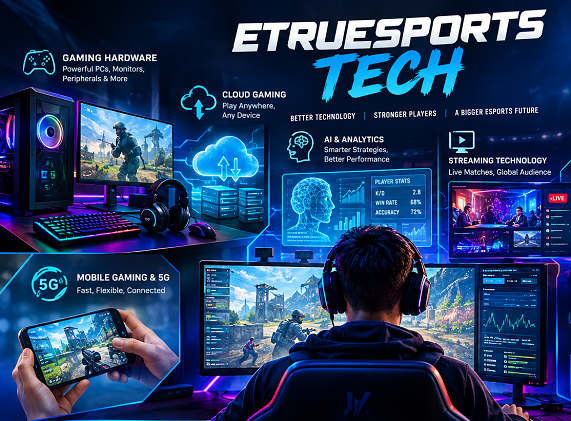
EtrueSports tech refers broadly to technology associated with modern esports and competitive gaming. It can include gaming hardware, software, internet infrastructure, artificial intelligence, analytics systems, streaming technology, tournament platforms, cybersecurity solutions, and immersive gaming technologies.
The concept is particularly relevant because esports requires technology at almost every level. A professional player needs a reliable computer or console, a responsive display, accurate peripherals, stable networking, and software optimised for performance. Meanwhile, tournament organisers need servers, anti-cheat systems, broadcasting tools, player statistics, and digital platforms.
In simple terms, etruesports tech represents the technological ecosystem that helps competitive gaming operate efficiently and evolve.
Why EtrueSports Tech Matters
Technology has always been important in gaming, but its role has become much greater as esports has grown into a global entertainment industry. Competitive players often depend on extremely small differences in reaction time, accuracy, network performance, and consistency.
A powerful gaming setup can deliver smoother gameplay and higher frame rates. A low-latency network can reduce delays between player actions and server responses. Advanced analytics can help competitors understand their strengths and weaknesses. Streaming technology allows millions of viewers to watch tournaments from almost anywhere.
As a result, technology affects both sides of esports: competitive performance and audience experience.
Major Components of EtrueSports Tech
1. High-Performance Gaming Hardware
Gaming hardware is one of the most visible parts of etruesports tech. Professional and serious competitive gamers frequently use hardware designed for speed, stability, and responsiveness.
Important components include:
- High-performance CPUs
- Dedicated graphics cards
- High-refresh-rate monitors
- Mechanical or optical keyboards
- Precision gaming mice
- Gaming headsets
- Specialised controllers
- High-speed storage
- Advanced cooling systems
A strong system can maintain stable frame rates during demanding gameplay. High-refresh-rate displays can also make fast-moving scenes appear smoother, which can be valuable in competitive games.
However, hardware alone does not create a professional player. Skills, practice, strategy, teamwork, and decision-making remain essential.
2. Gaming Displays and Low Latency
Modern gaming monitors have become an important part of competitive gaming technology. High refresh rates allow screens to update more frequently, while low response times can reduce visible delay.
For fast-paced competitive titles, players often look for displays that provide:
- High refresh rates
- Low response times
- Low input latency
- Appropriate resolution
- Adaptive synchronisation
- Consistent image quality
These technologies can make gameplay feel more responsive and fluid.
3. Internet and Networking Technology
A fast internet connection is not necessarily enough for competitive gaming. Stability and latency are equally important.
Latency describes the time required for information to travel between a player’s device and the game server. High latency can make gameplay feel delayed, while packet loss can cause interruptions or unpredictable behaviour.
Modern esports infrastructure therefore focuses on reliable servers, optimised routing, stable connections, and appropriate network configurations.
For competitive players, networking technology can be just as important as their gaming hardware.
4. Artificial Intelligence in Esports
Artificial intelligence is becoming increasingly useful across the gaming industry. AI can potentially support player analytics, matchmaking, moderation, automated highlights, coaching tools, and game development.
One interesting application is performance analysis. AI-powered systems can process large amounts of gameplay information and identify patterns that may be difficult for players to recognize manually.
For example, an analytics platform could examine statistics such as:
- Reaction patterns
- Accuracy
- Positioning
- Movement
- Resource management
- Team coordination
- Repeated strategic mistakes
AI can therefore become a useful assistant for players and coaches.
5. Data Analytics and Performance Tracking
Data has become one of the most valuable resources in professional esports.
Players and teams can collect large amounts of information during matches. Instead of relying only on personal observations, coaches can use statistics to understand what is happening during competition.
A performance dashboard might track:
| Technology Area | Main Purpose | Benefit |
|---|---|---|
| Gaming hardware | Run games efficiently. | Better performance |
| High-refresh monitors | Improve visual responsiveness | Smoother gameplay |
| Networking | Connect players to servers. | Lower latency |
| AI analytics | Analyse gameplay. | Better decision-making |
| Streaming technology | Broadcast competitions | Larger audiences |
| Cybersecurity | Protect accounts and events. | Greater security |
| Cloud technology | Deliver online services | Scalability |
| VR/AR | Create immersive experiences. | New gaming possibilities |
These technologies work together to create a modern competitive gaming ecosystem.
6. Streaming and Broadcasting Technology
Esports would not have the same global reach without streaming technology. Online broadcasting allows fans to watch competitions on computers, smartphones, tablets, smart TVs, and other connected devices.
Modern esports broadcasts can include:
- Live gameplay
- Player cameras
- Real-time statistics
- Instant replays
- Interactive graphics
- Automated highlights
- Live chat
- Multiple viewing perspectives
Streaming platforms have also created new opportunities for individual gamers. Players can build audiences through live streams, tutorials, reviews, entertainment content, and tournament coverage.
This makes broadcasting technology an important part of the larger etruesports tech ecosystem.
7. Cloud Gaming and Cloud Infrastructure
Cloud technology is another major development in gaming. Instead of depending entirely on a powerful local device, cloud gaming can process game workloads on remote servers and stream the result to the player.
Cloud infrastructure can also support esports organisations through online storage, analytics, tournament management, collaboration, and scalable services.
The biggest advantages can include accessibility and scalability. Players may not always need the most expensive hardware to access certain gaming experiences.
However, cloud gaming depends heavily on network quality. Latency, bandwidth, and server location remain important factors.
8. Virtual Reality and Augmented Reality
Virtual reality and augmented reality have the potential to create new forms of competitive gaming.
VR places players inside an immersive digital environment, while AR overlays digital information onto the physical world. As these technologies become more sophisticated, competitive games could offer experiences that differ significantly from traditional screen-based esports.
VR esports could eventually place greater emphasis on physical movement, spatial awareness, and immersive interaction.
Although VR competitive gaming is still developing compared with established esports categories, it represents an interesting area for future etruesports tech.
9. Cybersecurity and Anti-Cheat Technology
Competitive gaming depends on fair play. Cheating can damage tournaments, teams, players, and the trust of audiences.
For this reason, cybersecurity and anti-cheat systems are essential components of modern esports technology.
Anti-cheat solutions can monitor suspicious software, unusual behaviour, and unauthorised modifications. Security systems can also protect player accounts, tournament platforms, payment information, and organisational data.
As cheating techniques become more sophisticated, esports security technology must continue evolving.
Benefits of EtrueSports Tech
The growth of etruesports tech provides several advantages for players, teams, tournament organisers, and fans.
Better Competitive Performance
Modern hardware and software can help players achieve smoother gameplay and better access to performance information.
Improved Training
Analytics platforms can help identify weaknesses and measure progress over time. This makes training more data-driven.
Better Fan Experiences
Streaming, interactive statistics, instant replays, and advanced graphics can make esports broadcasts more engaging.
Greater Accessibility
Online tournaments and digital platforms allow players from different regions to participate in gaming communities without always needing to travel.
New Career Opportunities
Technology has created careers beyond professional playing. The esports ecosystem now includes analysts, coaches, broadcasters, streamers, tournament administrators, developers, designers, engineers, and content creators.
EtrueSports Tech and the Future of Gaming
The future of gaming technology is likely to become more connected, intelligent, and immersive.
Artificial intelligence could provide increasingly personalised coaching and recommendations. Cloud infrastructure may make gaming services more accessible across different devices. Advanced graphics technologies can continue improving visual quality and realism.
Wearable devices may also become more relevant to esports. Future systems could potentially analyse physical indicators such as movement, reaction patterns, or fatigue during training.
Another important trend is cross-platform gaming. As games become available across computers, consoles, and mobile devices, technology may continue reducing barriers between different gaming communities.
The esports industry is also likely to become more data-driven. Teams will increasingly use statistics and automated analysis to support decisions involving training, strategy, recruitment, and competition.
How Players Can Benefit From EtrueSports Tech
Players do not necessarily need the most expensive equipment to benefit from modern technology. The most important approach is to choose technology according to individual needs.
A beginner should prioritise a reliable system, a stable internet connection, comfortable peripherals, and a suitable monitor before spending heavily on premium equipment.
Intermediate players can consider performance tracking, better peripherals, upgraded displays, and structured training tools.
Competitive players may benefit from advanced analytics, professional-grade networking, specialized hardware, coaching platforms, and tournament-focused tools.
Technology should support skill development rather than replace it.
Choosing the Right Gaming Technology
When selecting gaming technology, players should consider several factors.
Performance: Make sure the hardware can comfortably run the games being played.
Reliability: Stable equipment is often more valuable than impressive specifications that do not improve actual gameplay.
Latency: Competitive players should pay attention to input and network latency.
Comfort: A mouse, keyboard, controller, or headset should be comfortable during long sessions.
Compatibility: Check whether hardware and software work properly with the chosen gaming platform.
Budget: Expensive equipment is not automatically better for every player.
The best setup is the one that matches the player’s requirements and provides consistent performance.
EtrueSports Tech for Esports Organisations
Technology is equally important behind the scenes. Esports organisations need digital systems to manage players, schedules, tournaments, statistics, communication, content, and audiences.
A professional organisation may use cloud services for collaboration, analytics systems for performance tracking, cybersecurity tools for protection, and broadcasting technology for media production.
Tournament organisers also need reliable servers and event-management systems. When thousands or millions of viewers follow an event, even a small technical problem can have a major impact.
This demonstrates that etruesports tech is not simply about gaming PCs. It encompasses the complete digital infrastructure supporting esports.
Challenges of EtrueSports Tech
Despite its benefits, advanced gaming technology presents several challenges.
One challenge is cost. High-end hardware can be expensive, creating differences between players with different financial resources.
Another issue is complexity. New technologies require users to understand specifications, compatibility, maintenance, and configuration.
Cybersecurity is also an ongoing concern. As gaming accounts and esports platforms become more valuable, they can attract attacks and fraudulent activity.
There is also the issue of technology becoming outdated. Hardware and software can evolve quickly, meaning players may feel pressure to upgrade frequently.
Therefore, responsible technology adoption should focus on practical value rather than simply following every new trend.
(FAQs)
What does etruesports tech mean?
EtrueSports tech broadly refers to technologies connected with competitive gaming and esports, including gaming hardware, networking, AI, analytics, streaming, cloud infrastructure, cybersecurity, and immersive technologies.
Why is technology important in esports?
Technology supports nearly every part of esports, including gameplay, training, tournaments, broadcasting, statistics, communication, and security.
Does expensive gaming hardware make someone a better esports player?
Not necessarily. High-quality hardware can improve consistency and responsiveness, but skill, practice, strategy, teamwork, and decision-making remain much more important.
How can AI help esports players?
AI can analyse gameplay data, identify patterns, support performance analysis, generate insights, and potentially provide personalised training recommendations.
Is internet speed important for competitive gaming?
Yes, but stability and latency are also important. A stable connection with low latency can provide a more consistent competitive experience.
What is the future of etruesports tech?
Future developments may include more advanced AI coaching, cloud gaming, immersive VR/AR esports, improved analytics, wearable technology, and increasingly sophisticated broadcasting systems.
Can beginners benefit from etruesports tech?
Yes. Beginners can use affordable and reliable technology to improve their gaming experience, track progress, learn from gameplay data, and gradually upgrade their equipment as their skills develop.
Is cybersecurity important in esports?
Yes. Cybersecurity helps protect player accounts, tournament platforms, organisational data, and competitive environments from unauthorised access, cheating, and other digital threats.
Conclusion
EtrueSports tech represents the growing relationship between technology, competitive gaming, and digital entertainment. From powerful gaming hardware and high-refresh-rate displays to AI analytics, cloud computing, streaming, cybersecurity, and immersive technologies, innovation is changing almost every part of esports.
The biggest advantage of these technologies is not simply better graphics or faster devices. Their real value comes from creating better ways for players to train, compete, communicate, analyse performance, and connect with fans.
As gaming technology continues to develop, etruesports tech is likely to become even more sophisticated. Players and organisations that understand technology and use it strategically can take advantage of new opportunities while avoiding unnecessary spending.
Ultimately, technology is a tool. Skills, creativity, teamwork, discipline, and strategy remain at the heart of competitive gaming. The future of esports will likely belong to those who combine these human qualities with the possibilities offered by emerging technology.