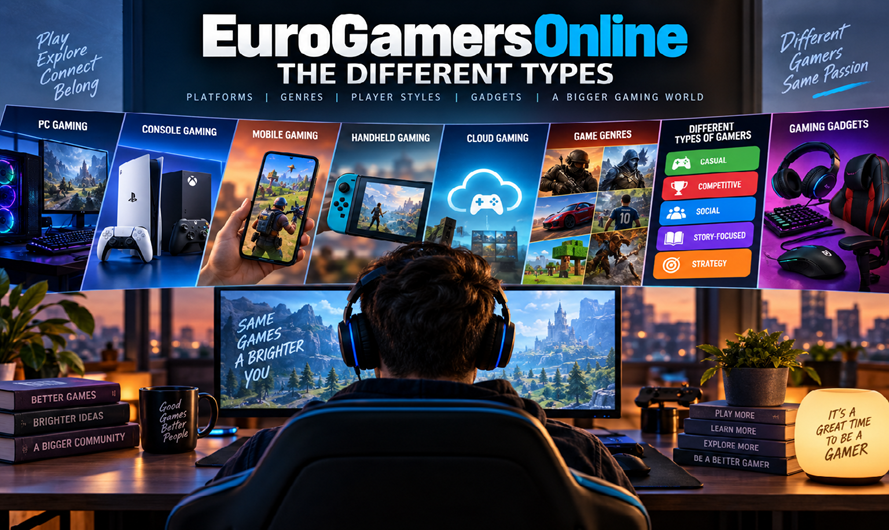

Gaming is no longer limited to one device, one genre, or one type of player. Today, people play on gaming PCs, consoles, handheld devices, and mobile phones. Some players enjoy competitive matches, while others prefer stories, puzzles, simulations, or relaxed multiplayer sessions.
That variety helps explain why searches for “eurogamersonline the different types” can have several meanings. Some people are looking for different types of games. Others want to understand different gaming platforms, player categories, or the main sections associated with EuroGamersOnline.
The current EuroGamersOnline website focuses on console gaming, PC gaming, and gadgets, while also publishing gaming news, reviews, hardware information, and industry-related content.
Therefore, the best way to understand EuroGamersOnline the different types is to look at gaming from several angles. These include platform types, game genres, player styles, and gaming experiences.
This guide explains those categories in simple terms so beginners and experienced players can understand where each type fits.
What Does EuroGamersOnline The Different Types Mean?
The phrase EuroGamersOnline the different types does not describe one specific game. Instead, it can be used as a broad search term for understanding the different categories connected with modern gaming.
Current online discussions use the phrase in several ways. Some sources classify games by genre, while others divide the subject into PC gaming, console gaming, gadgets, and different types of gamers.
This distinction matters because gaming preferences are highly personal.
For example, one person may enjoy playing competitive shooters on a PC. Another may prefer an adventure game on a console. Someone else may spend a few minutes each day playing a puzzle game on a mobile device.
All three are gamers, but their experiences are very different.
The Main EuroGamersOnline Types
The easiest way to understand the topic is to divide it into four major areas:
| Type | What It Covers | Best For |
|---|---|---|
| PC Gaming | Computer games, hardware, settings, performance | Players seeking flexibility |
| Console Gaming | PlayStation, Xbox, Nintendo, and console experiences | Simple and dedicated gaming |
| Gadgets | Gaming accessories and technology | Improving the gaming setup |
| Game Genres | RPGs, shooters, strategy, sports, puzzles, and more | Choosing the right game |
These categories overlap. A player might use a gaming PC, play an RPG, use a mechanical keyboard, and participate in multiplayer matches.
Understanding the differences makes it easier to choose games and equipment that match individual needs.
1. PC Gaming
PC gaming is one of the most flexible categories in the gaming industry. A computer can support a huge range of games, from simple indie titles to demanding AAA releases.
EuroGamersOnline’s current content includes PC gaming alongside console gaming and gadgets.
One major advantage of PC gaming is customization. Players can select their processor, graphics card, memory, storage, monitor, keyboard, mouse, and other components.
PC gaming also gives users more control over graphics settings. Depending on the hardware, players can adjust resolution, frame rates, textures, shadows, and other visual options.
Why Players Choose PC Gaming
Many players choose PCs because they offer flexibility.
A gaming PC can also serve other purposes, including work, education, video editing, streaming, and content creation. Players can upgrade individual components rather than replacing the entire system.
However, PC gaming can require more technical knowledge than console gaming. Players may need to update drivers, adjust settings, troubleshoot compatibility issues, or upgrade hardware.
For someone who enjoys customization, that flexibility can be a major advantage.
2. Console Gaming
Console gaming provides a more straightforward experience. Players purchase a console, connect it to a television or monitor, install games, and start playing.
The EuroGamersOnline website specifically identifies console gaming as one of its core areas. Its team page also describes dedicated expertise around console gaming, including classic retro systems and newer platforms.
Popular console ecosystems include PlayStation, Xbox, and Nintendo.
Benefits of Console Gaming
Console systems are attractive because they reduce the complexity of building a gaming setup.
Players do not normally need to choose individual graphics cards or processors. Developers optimize games for specific console hardware, creating a relatively consistent experience.
Consoles are also popular for living-room gaming. Players can connect a controller, sit comfortably, and enjoy games on a larger screen.
For families and casual players, this simplicity can make consoles appealing.
3. Gaming Gadgets and Accessories
Gaming is not just about the main device. Accessories can significantly change how a player interacts with games.
Gaming gadgets may include:
- Gaming headsets
- Mechanical keyboards
- Gaming mice
- Controllers
- Monitors
- Microphones
- Webcams
- Gaming chairs
- Storage devices
- Controller accessories
EuroGamersOnline describes gadgets and gaming technology as another part of its coverage.
The right accessory depends on the player’s needs.
A competitive PC player may prioritize a responsive mouse and high-refresh-rate monitor. A console gamer may care more about a comfortable headset and wireless controller.
Choosing Gaming Gadgets
Price should not be the only consideration.
A more expensive accessory is not automatically better for every player. Compatibility, comfort, durability, connection type, and intended use are equally important.
For example, someone who plays for 30 minutes a day may not need the same equipment as a competitive player who spends several hours practicing.
4. Casual Gaming
Casual players may enjoy puzzle games, simple strategy titles, card games, simulations, mobile games, or short multiplayer sessions.
The term “casual” does not mean a player lacks skill. It generally describes how much time, commitment, or competitive pressure the player wants from gaming.
A highly skilled player can still be a casual gamer if gaming is only an occasional hobby.
5. Competitive Gaming
Competitive gaming focuses on winning, improving skills, ranking, and measuring performance.
Players may participate in ranked matches, tournaments, leagues, or esports events.
Competitive games often demand quick reactions and strong decision-making. However, mechanical skill is only part of the equation.
Players may also need communication, teamwork, map knowledge, strategy, and consistent practice.
Competitive gaming can therefore appeal to players who enjoy measurable progress and challenging opponents.
6. Role-Playing Games
Role-playing games, commonly called RPGs, emphasize characters, progression, exploration, and storytelling.
Players may create or control characters while completing quests, collecting equipment, developing abilities, and making decisions.
Some RPGs focus heavily on narrative. Others emphasize combat and character progression.
RPGs are particularly appealing to players who enjoy long-term progression.
A short game may provide entertainment for several hours, while a large RPG can keep players engaged for dozens or even hundreds of hours.
7. Action and Shooter Games
Action games emphasize movement, combat, reflexes, and immediate decisions.
First-person shooters, or FPS games, are one of the best-known examples. These games place the player directly into the action and often require accuracy and fast reactions.
Some shooters focus on competitive multiplayer. Others provide cinematic campaigns or cooperative missions.
Action games are ideal for players who prefer energetic gameplay rather than slow progression.
8. Strategy Games
Strategy games reward planning rather than pure reaction speed.
Players may control armies, build cities, manage resources, develop economies, or make tactical decisions.
Strategy games can be divided into several styles, including real-time strategy and turn-based strategy.
These games are useful for players who enjoy analyzing situations and thinking several steps ahead.
Unlike some action games, strategy titles may give players more time to consider their next move.
9. Simulation Games
Simulation games attempt to recreate real-world or fictional systems.
Examples include city-building games, farming simulations, vehicle simulators, business-management games, and life simulations.
These games can be relaxing because they allow players to progress at their own pace.
They can also provide a sense of creativity. Players may design cities, manage businesses, customize homes, or create virtual communities.
10. Sports and Racing Games
Sports and racing games bring familiar real-world activities into digital environments.
Players can participate in football, basketball, soccer, baseball, racing, and other sports.
These games can appeal to both sports fans and competitive gamers.
Racing games, for example, may range from arcade-style experiences to detailed driving simulations. The choice depends on whether the player wants accessibility or realism.
11. Puzzle and Brain Games
Puzzle games focus on logic, patterns, memory, problem-solving, and decision-making.
They are often easy to understand but can become increasingly challenging.
Puzzle games are also suitable for shorter gaming sessions. A player can complete a few challenges without committing to a long campaign.
That makes this category particularly attractive to casual gamers.
12. Multiplayer and Social Gaming
Multiplayer gaming adds a social element to the experience.
Instead of playing alone, users can compete or cooperate with friends and other players.
Multiplayer games can include cooperative adventures, competitive shooters, MMORPGs, strategy games, sports titles, and social experiences.
Communication is often just as important as gameplay.
Teams may need voice chat, text communication, or carefully planned strategies to succeed.
Different Types of Gamers
Game genres are only one way to understand the different types of gaming.
Players themselves can also have different motivations.
Casual Gamers
Casual gamers usually play for relaxation and entertainment. They may not follow competitive rankings or spend heavily on equipment.
Competitive Gamers
Competitive gamers enjoy winning, improving, and testing their skills against other players.
They may spend considerable time practicing and learning advanced techniques.
Social Gamers
Social gamers value the people they play with. The game itself may be important, but the social experience is often the main attraction.
Story-Focused Gamers
Story-focused players enjoy characters, dialogue, world-building, and emotional narratives.
They may prefer RPGs, adventure games, and cinematic single-player experiences.
Retro Gamers
Retro gamers enjoy older games, classic consoles, arcade experiences, and traditional gameplay mechanics.
Some players enjoy retro gaming because of nostalgia. Others appreciate the simplicity and design of older titles.
How to Choose the Right Type of Gaming
There is no universal “best” type of gaming.
Instead, the right choice depends on your interests, budget, available time, and preferred level of challenge.
Use these questions as a starting point:
Do you want simplicity?
A console may be a better fit.
Do you want customization?
PC gaming offers more hardware and software flexibility.
Do you enjoy competition?
Look for competitive multiplayer and esports-focused games.
Do you prefer stories?
RPGs and adventure games may suit you.
Do you want short sessions?
Puzzle, casual, and mobile-friendly games can work well.
Do you enjoy social interaction?
Multiplayer and cooperative games provide more opportunities to play with others.
EuroGamersOnline The Different Types: Quick Comparison
| Gaming Type | Main Advantage | Potential Challenge |
|---|---|---|
| PC Gaming | Customization and flexibility | Hardware can be expensive |
| Console Gaming | Easy setup | Less hardware flexibility |
| Casual Gaming | Easy to start | May offer less depth |
| Competitive Gaming | Skill development | Can be demanding |
| RPG Gaming | Deep progression and stories | Long time commitment |
| Strategy Gaming | Strong mental challenge | Steeper learning curve |
| Simulation Gaming | Creativity and realism | Can feel slow to some players |
| Puzzle Gaming | Quick and accessible | Limited appeal for action fans |
| Multiplayer Gaming | Social interaction | Requires internet and other players |
| Retro Gaming | Classic design and nostalgia | Older graphics and systems |
Why Understanding Different Gaming Types Matters
Understanding these categories can save both time and money.
A beginner may buy expensive hardware without knowing what games they actually enjoy. Another player may choose a complex game when they really want something relaxing.
By identifying your preferred style first, you can make better decisions.
For example, a competitive PC gamer may benefit from investing in performance hardware. A casual console player may get more value from a comfortable controller and headset.
This is why the concept behind EuroGamersOnline the different types is useful. It encourages players to think about gaming as a broad ecosystem rather than a single activity.
(FAQs) About EuroGamersOnline The Different Types
What is EuroGamersOnline the different types?
EuroGamersOnline the different types is a broad term used to discuss different gaming categories, platforms, genres, player styles, and gaming experiences.
What are the main EuroGamersOnline categories?
The current EuroGamersOnline website focuses primarily on console gaming, PC gaming, and gadgets, alongside gaming news, reviews, hardware insights, and industry trends.
Is PC gaming better than console gaming?
Neither is automatically better. PC gaming provides more customization, while consoles offer a simpler and more consistent setup.
What type of gaming is best for beginners?
Casual games and accessible console games are often good starting points. However, the best choice depends on personal interests.
What are the main game genres?
Common genres include RPGs, shooters, action games, strategy games, simulations, sports, racing, puzzles, and multiplayer games.
What is a casual gamer?
A casual gamer typically plays for entertainment without making gaming a major competitive commitment.
What is a competitive gamer?
A competitive gamer focuses on improving skills, winning matches, rankings, tournaments, or esports competition.
Are gadgets part of EuroGamersOnline?
Yes. EuroGamersOnline identifies gadgets alongside PC and console gaming as areas of its gaming and technology coverage.
What gaming platform is best for multiplayer games?
PCs and modern consoles can both provide strong multiplayer experiences. Your choice should depend on the games you want to play and the people you want to play with.
Are RPGs suitable for casual gamers?
They can be. Some RPGs are designed for relaxed play, while others require significant time and commitment.
What makes strategy games different?
Strategy games emphasize planning, resource management, tactics, and decision-making rather than relying primarily on reflexes.
What are retro games?
Retro games generally refer to older games or experiences inspired by classic gaming systems and arcade design.
Final Thoughts
EuroGamersOnline the different types is best understood as a broad look at the many ways people experience gaming.
PC gaming offers customization and performance options. Console gaming provides convenience and dedicated hardware. Gadgets can improve the overall setup. Meanwhile, genres such as RPGs, shooters, strategy, simulation, sports, racing, and puzzles give players different ways to enjoy games.
Player preferences also matter. Casual gamers may want simple entertainment, while competitive players may focus on rankings and skill development. Story-focused gamers can spend hours exploring fictional worlds, while social gamers may care most about playing with friends.
There is no single correct way to be a gamer.
The best gaming experience is the one that fits your interests, time, budget, and preferred style. By understanding the different types, players can make smarter choices about games, platforms, and equipment while getting more enjoyment from the hobby.



Pingback: Gaming Etruesports – Complete Guide to Modern Esports 2026